Home | Forms Library | How to File | Decision Flow | Contact
Form 1040 Guide for Expats
Form 1040 is the main U.S. individual tax return. The expat forms and schedules do not replace it. They either feed into it, attach to it, or sit alongside it as separate reporting requirements.
Form 1040 Is Where the Return Comes Together
Many expats get overwhelmed because they look at Form 1040 first and then wonder where all the foreign income, exclusions, credits, business income, and account reporting fit.
The cleaner way to think about it is this: Form 1040 is the center of the return, but many of the hard calculations happen on supporting forms first.
Advertisement
What Form 1040 Does
Form 1040 reports your main individual income tax picture for the year. It brings together income, deductions, taxes, credits, payments, refunds, and balances due.
For Americans abroad, Form 1040 still matters because U.S. citizens and many U.S. taxpayers abroad may have a filing requirement even when they live outside the United States or pay taxes in another country.
The expat part of the return usually comes from the supporting forms that connect to Form 1040, such as Schedule 1, Schedule C, Schedule SE, Form 2555, Form 1116, and sometimes Form 8938.
Source: IRS About Form 1040.
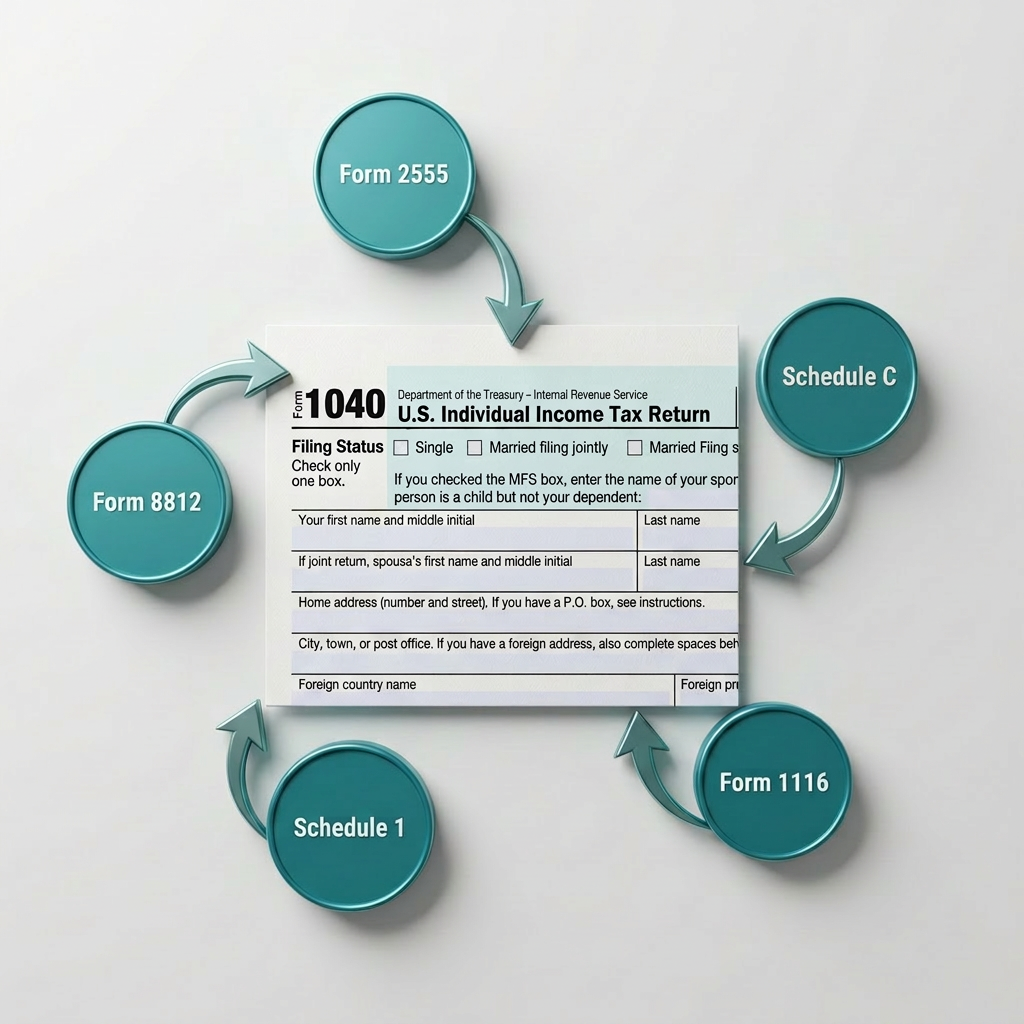
How Supporting Forms Connect to Form 1040
Form 1040 is not usually where a self-employed expat starts. It is where the supporting pieces eventually land.
FBAR is different. It does not attach to Form 1040. It is filed separately, but it may still be part of your overall filing responsibility if you have foreign accounts.
The Correct Order Matters
A lot of tax confusion comes from trying to complete the main return before the supporting forms are organized. For expats, that can turn into a mess quickly.
The better order is to first understand your filing situation, income type, foreign income path, self-employment status, and foreign account reporting. Then the numbers can flow into Form 1040 more cleanly.
If you are self-employed
Start with Schedule C to organize business profit, then Schedule SE to review self-employment tax, then Schedule 1 and Schedule 2 where the results connect into Form 1040.
If you have foreign earned income
Compare Form 2555 and Form 1116 before choosing a path. Do not assume both are automatic, and do not treat them like casual year-by-year switches.
If you have foreign accounts
Review FBAR and Form 8938 separately. FBAR is not attached to Form 1040, but Form 8938 may be attached to the return when reporting thresholds are met.
If you own a foreign company
Slow down and map the business structure first. Foreign company ownership can create income reporting, account reporting, asset reporting, or entity reporting questions.
Do / Don’t Guidance
Do treat Form 1040 as the main return
Form 1040 is where the return comes together. Supporting schedules and expat forms help calculate or report pieces of the return, but Form 1040 remains the central individual tax return.
Think of it as the final table where the supporting forms bring their numbers.
Don’t start with Form 1040 if the pieces are not ready
If you are self-employed, have foreign earned income, paid foreign tax, or have foreign accounts, the supporting forms need to be reviewed first. Otherwise Form 1040 turns into a guessing game.
This is how people end up bouncing around the return and getting frustrated.
Do separate attached forms from separate filings
Some forms attach to Form 1040. Some do not. Form 8938 may attach to the return when required. FBAR is filed separately through FinCEN.
This matters because “I filed my tax return” does not always mean every foreign reporting requirement was handled.
Don’t assume no tax means no filing issue
Many expats owe little or no regular U.S. income tax after exclusions or credits, but that does not automatically remove the filing requirement.
You may still need to file the return, report foreign accounts, attach required forms, or address self-employment tax.
FEIE and FTC Do Not Replace Form 1040
Form 2555 and Form 1116 are part of the foreign income decision, but they do not replace the main tax return. They connect into the Form 1040 filing picture.
This is also why the FEIE vs. FTC decision matters. Form 2555 and Form 1116 are different paths, and the choice can affect both the current return and future years.
Common Mistakes
Trying to complete Form 1040 first
Form 1040 is the main return, but it may not be the best starting point. If supporting forms are not ready, the main return will not make much sense.
Assuming FEIE removes everything
FEIE may reduce regular U.S. income tax on qualifying foreign earned income, but it does not automatically remove self-employment tax, foreign account reporting, or the need to file.
Missing Schedule SE
Self-employed expats may still need to review Schedule SE even when Form 2555 reduces regular income tax. Income tax and self-employment tax are not the same calculation.
Forgetting separate foreign account reporting
FBAR is separate from Form 1040. If you had foreign accounts, the account reporting question still needs to be reviewed.
Using the wrong foreign income path
Form 2555 and Form 1116 are not duplicate forms to pile onto the return. Compare the FEIE and FTC paths before choosing.
Losing the filing sequence
Expat returns feel chaotic when the forms are handled out of order. Following the flow makes the return much easier to understand.
When Form 1040 Becomes More Complex
Form 1040 becomes more layered when several supporting issues are involved at once: self-employment income, foreign earned income, foreign taxes paid, foreign accounts, foreign companies, investment income, multiple countries, or prior-year filing gaps.
The answer is not to treat the return like a pile of unrelated forms. The answer is to map the filing picture: what income do you have, which forms calculate it, which forms report it, and where does each result land on Form 1040?
Behind on Filing?
If you have not filed for several years, Form 1040 is only one part of the catch-up picture. You may also need to review prior-year foreign income choices, self-employment income, foreign accounts, FBARs, and any foreign entity or asset reporting.
Start with the catch-up filing guide before trying to rebuild everything one form at a time.
Advertisement
Related Guides
Use these guides to understand the forms and filing areas that connect to Form 1040.
Schedule C Guide
Understand how self-employed business profit is calculated.
Schedule SE Guide
See how self-employment tax connects to the return.
Schedule 1 Guide
Learn how additional income and adjustments connect into Form 1040.
FEIE vs. FTC
Compare the foreign income exclusion and foreign tax credit paths.
FBAR Requirements
Review foreign account reporting that is filed separately from Form 1040.
Form 8938 Guide
Review specified foreign financial asset reporting attached to the return.
Disclaimer: This guide is for general educational purposes only and is not legal, tax, or accounting advice. U.S. expat tax rules can change and individual facts matter. Review current IRS guidance or consult a qualified tax professional before filing.